Candide: Optimism, Interrogated in Rococo
📷 photos by LA opera
Optimism is the only philosophy required to survive its own refutation nightly, in public, at full volume, and still land the high note.
Opening night at LA Opera began the right way, with a conversation, and then the work itself took over the argument: Candide at the Dorothy Chandler Pavilion, Leonard Bernstein's hybrid of opera and Broadway, in Francesca Zambello's production, conducted by Resident Conductor Lina González-Granados. The source is the sharpest short novel ever smuggled into the canon, Voltaire's Candide of 1759, and the evening makes full sense once you hold that lineage in view. Voltaire wrote his novella as an assassination, aimed at the fashionable metaphysics of his century, the doctrine, borrowed from Leibniz and put into the mouth of the tutor Dr. Pangloss, that we live in the best of all possible worlds. Bernstein, two centuries later, understood that the correct weapon against a complacent idea is not a lecture but a tune you cannot stop humming. The satire sings. That is why it survives.
The plot is a controlled experiment disguised as a picaresque. Candide, played by Duke Kim with the exact luminosity the role demands, a goodness so sincere it functions as instrumentation, is expelled from paradise and sent through the institutions of his world one by one: war, the Church and its Inquisition, wealth, colonial adventure, love itself in the person of Meghan Picerno's Cunegonde. Each system receives him with a theory, and each theory fails him in practice, and Pangloss, played by Scott Bakula, who doubles as Voltaire himself, the author narrating his own trap, simply adjusts the doctrine and continues. Here is the sociological core of the piece, and the reason it plays in 2026 like it was written last spring. Optimism, Candide proposes, is rarely a conclusion drawn from evidence. It is a social technology, the ideology of those whom the world has not yet billed, a way of converting other people's catastrophes into one's own serenity. The comedy is the sound of that technology breaking, scene by scene, in the hands of a boy too honest to stop reporting what he sees.
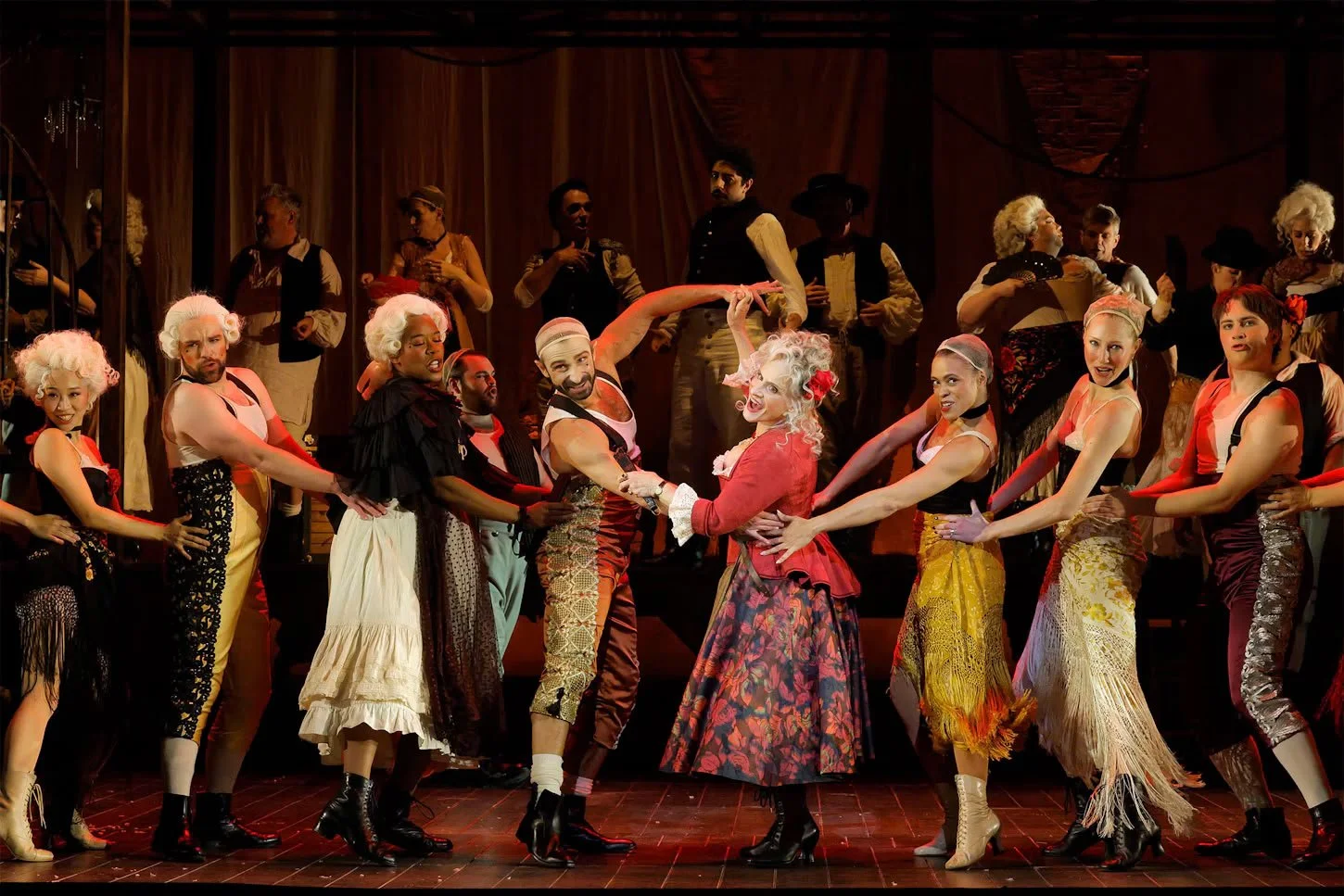
And then there are the optics, which this production understands as argument rather than ornament. James Noone's sets and Jennifer Moeller's costumes deliver the eighteenth century in full Rococo bloom, all gilt and flourish and rapidly transforming splendor, while the narrative underneath keeps administering earthquakes, executions, and ruin. The eye is being offered the best of all possible worlds at the exact rate the ear is told it does not exist, and the friction between those two reports is the production's intelligence made visible. Patti LuPone's Old Lady anchors the lesson from the far side of experience: she has lost everything the plot can take, including, famously, a buttock, and she remains the most alive person on the stage, because her optimism has been replaced by something more durable, appetite for the next scene. Survival, in her performance, is not a philosophy. It is a practice.
Which is where Voltaire, and Bernstein after him, finally land their hero, and their audience. The novel's famous conclusion refuses both Pangloss and despair: we must cultivate our garden. Read after an evening like this one, the line stops sounding like resignation and starts sounding like the only serious program on offer, metaphysics retired in favor of work, the world improved at the scale of one's own hands. A conversation, a stage full of gilt ruins, a score that grins while it grieves. Candide makes sense because every century believes it has outgrown the need to be told that hope is a discipline rather than a mood. Every century is wrong in the same way, and every century, luckily, gets its production.
Yi Zhou