📷 photos courtesy of Francis Ford Coppola Winery
A photograph can hold an entire argument about fame, if the fame has been arranged honestly.
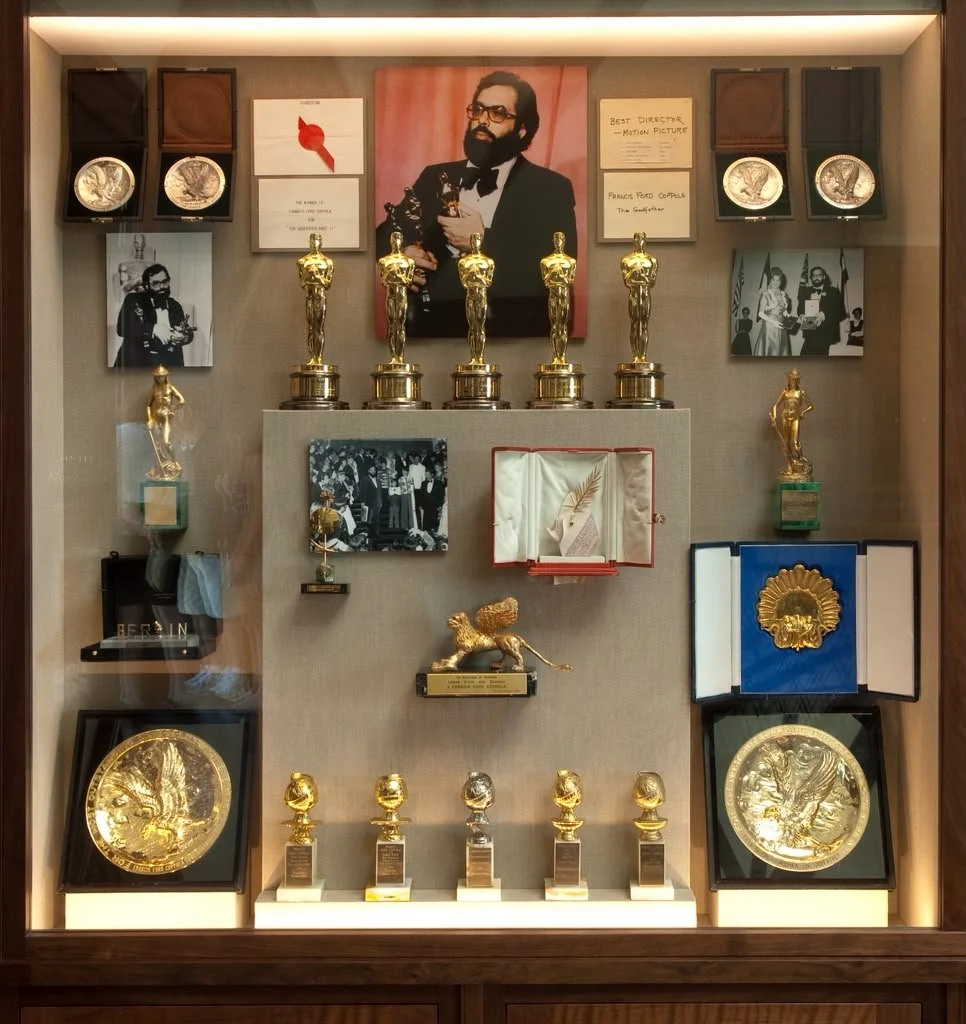
This one shows the awards case inside the museum at the Francis Ford Coppola Winery, and its power is in the inventory: five Academy Awards in a row, their gold catching the Sonoma light like a family portrait of everything the industry can give a person. Beside them, the Golden Globes. The Palme d'Or, which Cannes does not hand out carelessly. The Golden Lion of Venice. Half a century of verdicts, rendered in metal, gathered into a few feet of glass. Any one of these objects is the summit of a thousand careers that ended one envelope away. Here they stand together, at eye level, in a winery, while outside the windows the harvest does its unglamorous, eternal work of actually ripening.
The sociology of trophies is stranger than we admit. An award is applause, frozen at the exact temperature of one evening and then required to represent a lifetime. It does not age, which is its lie; the work ages, the artist ages, the audience that cheered has been replaced twice over, and still the statuette stands at permanent attention, insisting the moment is now. Coppola's arrangement quietly corrects the lie, and I think that is why the photograph moves me. He has placed the frozen applause in the one environment that understands time better than cinema does: a winery, where value is measured in years, where nothing is allowed to pretend that the vintage of a single night is the whole story. The gold does not dominate this estate. It resides in it, one citizen among the vines, the barrels, the desk from The Godfather, the red Tucker turning slowly nearby. Glory, domesticated, is glory finally telling the truth about itself: it was never the point. It was the receipt.
And there is a novelist's detail in the glass itself. You see the awards, and you see, faintly, your own reflection standing in front of them, every visitor briefly superimposed on the evidence, asking the question the case exists to ask: what would your shelf hold, and what did it cost, and was the work, in the end, worth more than the metal? Coppola, who risked his fortune on his films more than once, who mortgaged the present for the work again and again, has arranged his receipts where his wine sleeps, as if to file the final report of that lifelong wager: the gold stayed. The work stayed longer. Photograph the case and you photograph both, the applause and the silence after it, sharing one frame at last.
Yi Zhou