
📷 photos courtesy of Francis Ford Coppola Winery And YiZhouStudio
Bocce: The Philosophy of Closeness
The bocce courts are where the Francis Ford Coppola Winery stops being a museum of one man's career and becomes something older and more democratic: an Italian afternoon, reproduced with total conviction under a Sonoma sun.
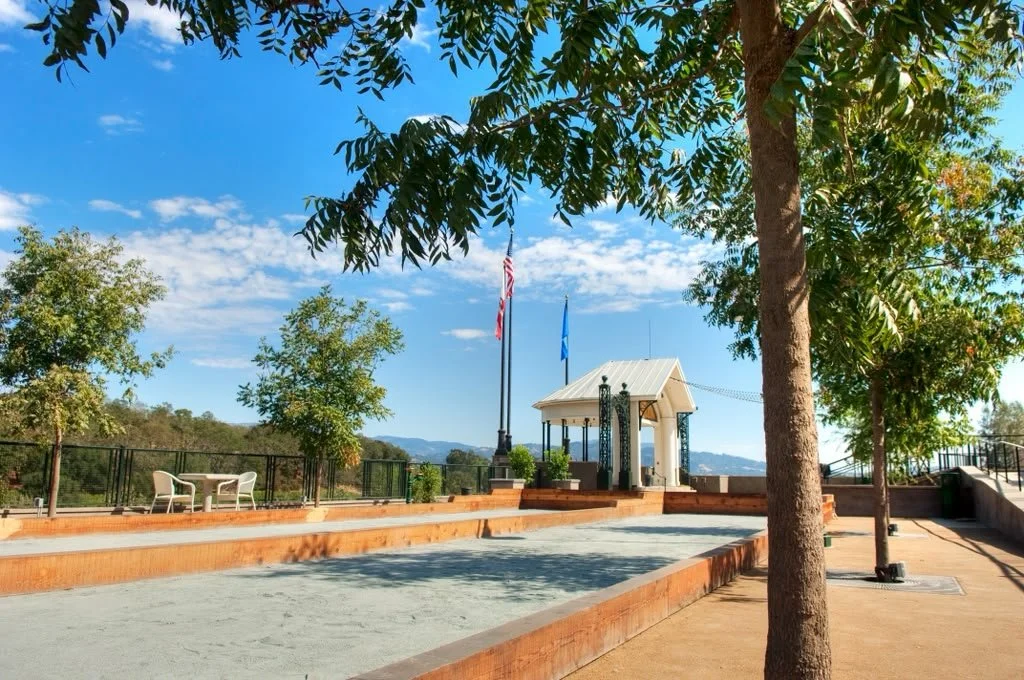
Look at the photographs the way the game asks to be played, slowly. The courts run long and pale between their wooden borders, gravel combed, a green fountain standing by like an usher from another century. Through the willow leaves the light comes down in green coins. At the far end, two plastic chairs wait with the patience of old friends. In the closest frame, the balls rest where they landed, dark spheres holding their small distances from one another, a solar system of almosts. Nothing in these images is triumphant. Everything is near. That is the entire teaching of bocce, and it takes most of us a lifetime to learn it anywhere else.
Every other sport worships the blow: the strike, the goal, the knockout, the checkmate. Bocce worships approach. You send your ball down the court not to hit the target but to keep it company, to finish as close to the pallino as physics and humility allow. Points are awarded for nearness. I can think of no other game, and very few religions, that score human beings this way. It is a technology for measuring affection disguised as a pastime, invented by a civilization that understood competition would happen anyway and chose to wrap it in conversation, shade, and an unhurried afternoon. Romans played a version of it. Italian grandfathers perfected it into social law: you can play bocce at eight years old and at eighty eight, badly dressed or beautifully, winning or losing, and the talk between throws is never, ever the intermission. The talk is the event. The balls are punctuation.
Coppola's Sicilian inheritance is usually discussed in terms of opera, Catholicism, and revenge. The bocce courts propose a fourth term: tenderness at scale. The man who filmed the Corleones also built, for strangers, the exact ground where Italian America has always healed itself, the long court behind the feast, where the old country and the new one roll toward the same small white point and agree, for an afternoon, on what close enough means. There is even a director's lesson buried in the gravel. A film, like a bocce ball, is not required to strike its subject dead center. It is required to land near the truth and stay there, in the light, where everyone can walk down the court and measure the distance with their eyes.
Evening comes over the courts and the game simply dissolves into the estate, the way the best scenes dissolve into a life. The roses guard the vines. The books guard the boy. The cabins guard the summer. And the bocce courts guard the oldest Italian proposition of all: that getting close is the victory, and everything else is just keeping score.
Yi Zhou