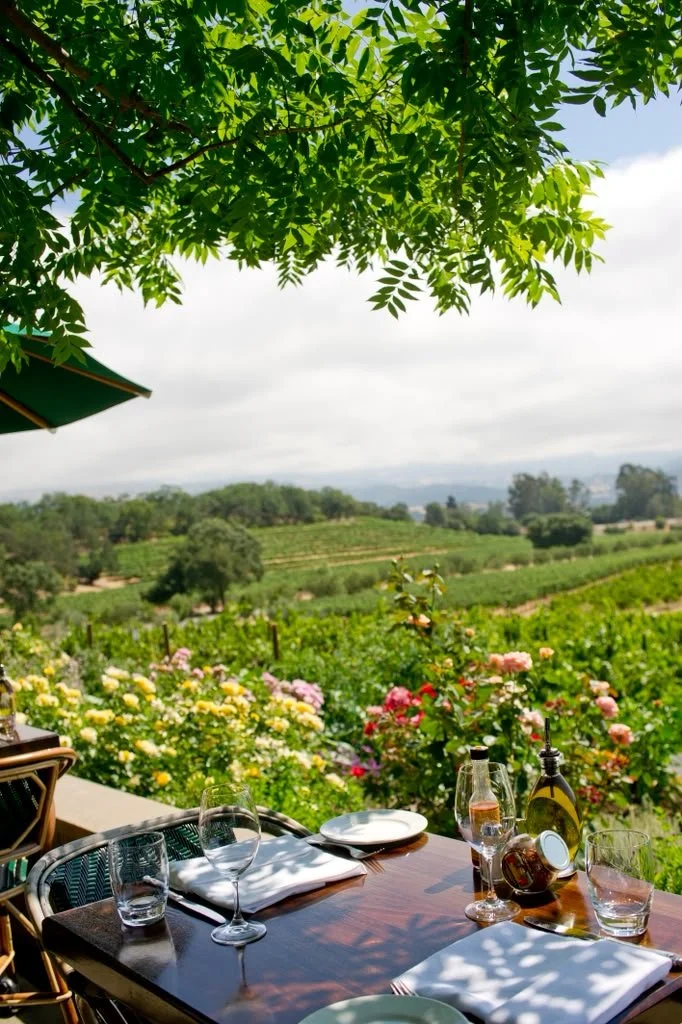
📷 photos courtesy of Francis Ford Coppola Winery and Yi Zhou Studio
Begin with the roses, because the estate does.
They are planted at the head of the vine rows, and the reason is a small tragedy disguised as a custom: the rose is weaker than the vine. Mildew finds it first. Disease announces itself in the rose while the grapes are still innocent, so the grower walks the rows reading flowers the way a doctor reads a face, looking for the first sign. The most delicate thing in the field is given the most dangerous position. Every artist who has ever lived understands the assignment. The sensitive instrument goes at the front. It suffers earliest, and its suffering is information, and the whole harvest survives because something beautiful agreed to be vulnerable in public.
Then lift your eyes, the way the photographs ask you to, and the poetry widens into geography. Row behind row of vines ruled across the hills with a draftsman's patience, each line converging the way perspective converges in a painting, except no painting ever smelled of warm earth and green. The roses repeat at intervals, yellow, red, pink, pink again, a rhythm the eye starts to anticipate and then to need, the way a chorus needs its refrain. At the end of the day the sun lowers itself into the arrangement and the whole valley changes tense, green going gold, gold going amber, the rows holding their formation while the light resigns. An old vine stands apart, twisted by decades into something with a spine and a history, still leafing, still working. If it were cast in a film you would call it the character part, the face the camera trusts.
I am a composer before anything, so permit me the translation I cannot resist. The rows are staff lines. The hills are the page. The roses are the notes that lean outside the measure, bright and a little excessive, exactly where the emotion gets in. A vineyard is a score that takes all year to play, and Coppola, the most operatic of directors, has been writing his longest work in this notation, season after season, in a medium that can be drunk but first must be looked at. The gate with his name in gold was only the title card. This is the film.
And there is something quietly moving about the stage of life it represents. The fairy tales of youth are about entering the enchanted place. The fairy tales of mastery are about building one and then planting its borders with guardians who bloom. Coppola conquered cinema early and spent his later decades turning land into the same argument his films always made: that abundance is a discipline, that romance survives by being engineered, that the feast is a form of thought.
The roses go first, into the weather, into the season, into the frame. Everything behind them is protected by their example. It is the oldest arrangement in art, and standing among them, in that light, it still feels like news.
Yi Zhou