Tenderness at Scale: An Italian Afternoon at Coppola’s Winery

📷 photos courtesy of Francis Ford Coppola Winery And YiZhouStudio

Bocce: The Philosophy of Closeness

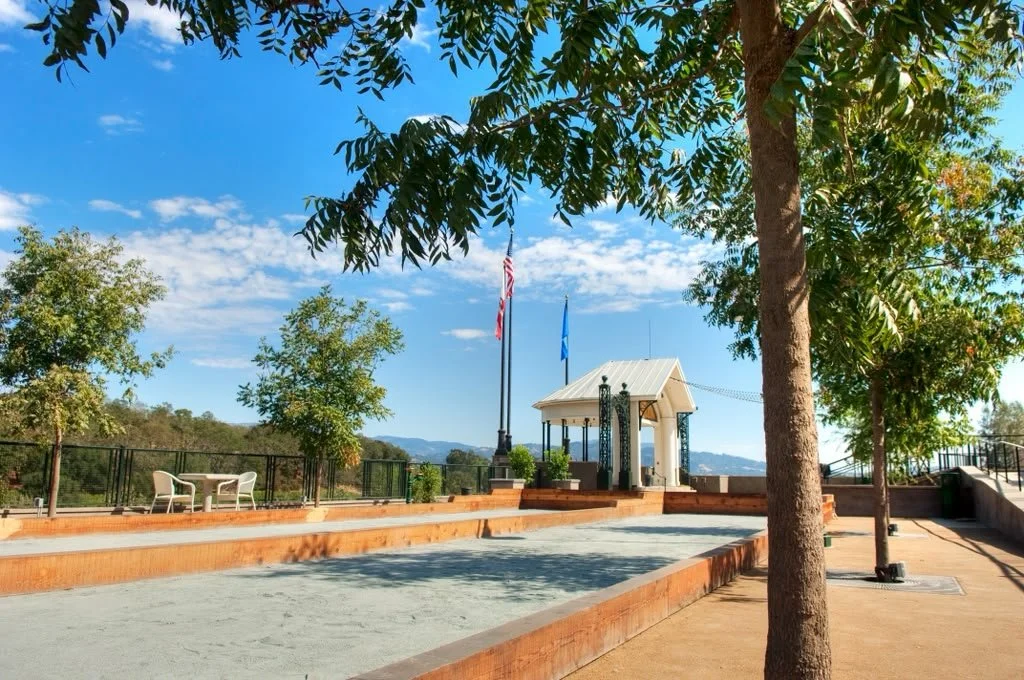
The bocce courts are where the Francis Ford Coppola Winery stops being a museum of one man's career and becomes something older and more democratic: an Italian afternoon, reproduced with total conviction under a Sonoma sun.

Look at the photographs the way the game asks to be played, slowly. The courts run long and pale between their wooden borders, gravel combed, a green fountain standing by like an usher from another century. Through the willow leaves the light comes down in green coins. At the far end, two plastic chairs wait with the patience of old friends. In the closest frame, the balls rest where they landed, dark spheres holding their small distances from one another, a solar system of almosts. Nothing in these images is triumphant. Everything is near. That is the entire teaching of bocce, and it takes most of us a lifetime to learn it anywhere else.

Every other sport worships the blow: the strike, the goal, the knockout, the checkmate. Bocce worships approach. You send your ball down the court not to hit the target but to keep it company, to finish as close to the pallino as physics and humility allow. Points are awarded for nearness. I can think of no other game, and very few religions, that score human beings this way. It is a technology for measuring affection disguised as a pastime, invented by a civilization that understood competition would happen anyway and chose to wrap it in conversation, shade, and an unhurried afternoon. Romans played a version of it. Italian grandfathers perfected it into social law: you can play bocce at eight years old and at eighty eight, badly dressed or beautifully, winning or losing, and the talk between throws is never, ever the intermission. The talk is the event. The balls are punctuation.

Coppola's Sicilian inheritance is usually discussed in terms of opera, Catholicism, and revenge. The bocce courts propose a fourth term: tenderness at scale. The man who filmed the Corleones also built, for strangers, the exact ground where Italian America has always healed itself, the long court behind the feast, where the old country and the new one roll toward the same small white point and agree, for an afternoon, on what close enough means. There is even a director's lesson buried in the gravel. A film, like a bocce ball, is not required to strike its subject dead center. It is required to land near the truth and stay there, in the light, where everyone can walk down the court and measure the distance with their eyes.

Evening comes over the courts and the game simply dissolves into the estate, the way the best scenes dissolve into a life. The roses guard the vines. The books guard the boy. The cabins guard the summer. And the bocce courts guard the oldest Italian proposition of all: that getting close is the victory, and everything else is just keeping score.

Yi Zhou
The Purest Leading Man in Hollywood: Reflections on Air Bud Returns

📷 photos courtesy of Yi Zhou and YiZhouStudio

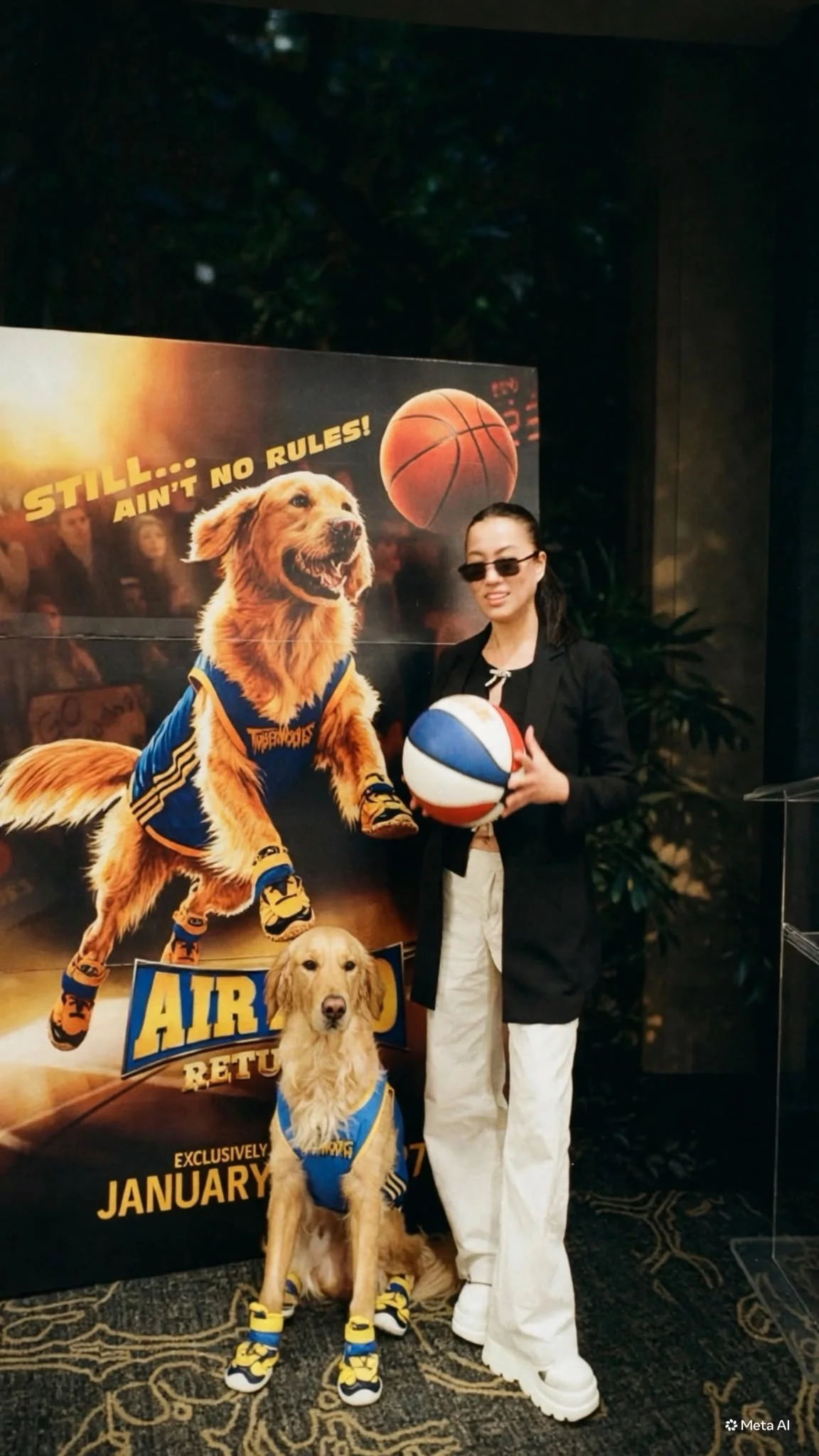
Nobody tell the critics, but the most professional actor I met this season has four legs, a coat the color of late afternoon, and a jump shot.

The occasion was a screening of Air Bud Returns at the AMC in Century City, and the guest of honor was Buddy himself, present in the fur, working the room with the serene confidence of a star who has never once read a review. I was happy to meet him in a way I am slightly embarrassed to quantify. You have to understand: every other performer in this town arrives with a narrative. Buddy arrives with a ball.

Let us be critics for a moment, because the film deserves the compliment of being taken seriously at exactly its own temperature. The Air Bud premise has always rested on the greatest sentence in American jurisprudence: there ain't no rule says a dog can't play basketball. Critics in 1997 treated this as a gag. It is actually a philosophy, a loophole in the social contract through which joy, pure and unlicensed, dribbles straight down the court. Rules govern what is forbidden; they are silent about what is possible, and into that silence steps a golden retriever. Nearly thirty years later, the franchise returns to find the loophole still open and the audience, several generations deep now, still walking through it holding their children's hands.

The sociology of the screening was its own review. Century City on a screening afternoon is usually a parade of professional detachment, people composing their opinions before the credits finish. Not here. Here the room regressed, gratefully, to the exact age at which a dog playing basketball is not a premise but a promise. And Buddy, meeting his public afterward, gave a masterclass in the lost art of being a movie star: present, unbothered, equally kind to every camera, entirely uninterested in his own myth. Method actors study presence for years. Retrievers are born with it and shed it everywhere.

Is Air Bud Returns cinema? The question is beneath the film and the dog. It is something rarer in this season of contenders and campaigns: it is delight, delivered without an agenda, by the only leading man in Hollywood whose entire performance is sincerity. Long may he retrieve.

Yi Zhou

The Cabins: Deauville in Sonoma

📷 photos courtesy of Francis Ford Coppola Winery and Yi Zhou Studio

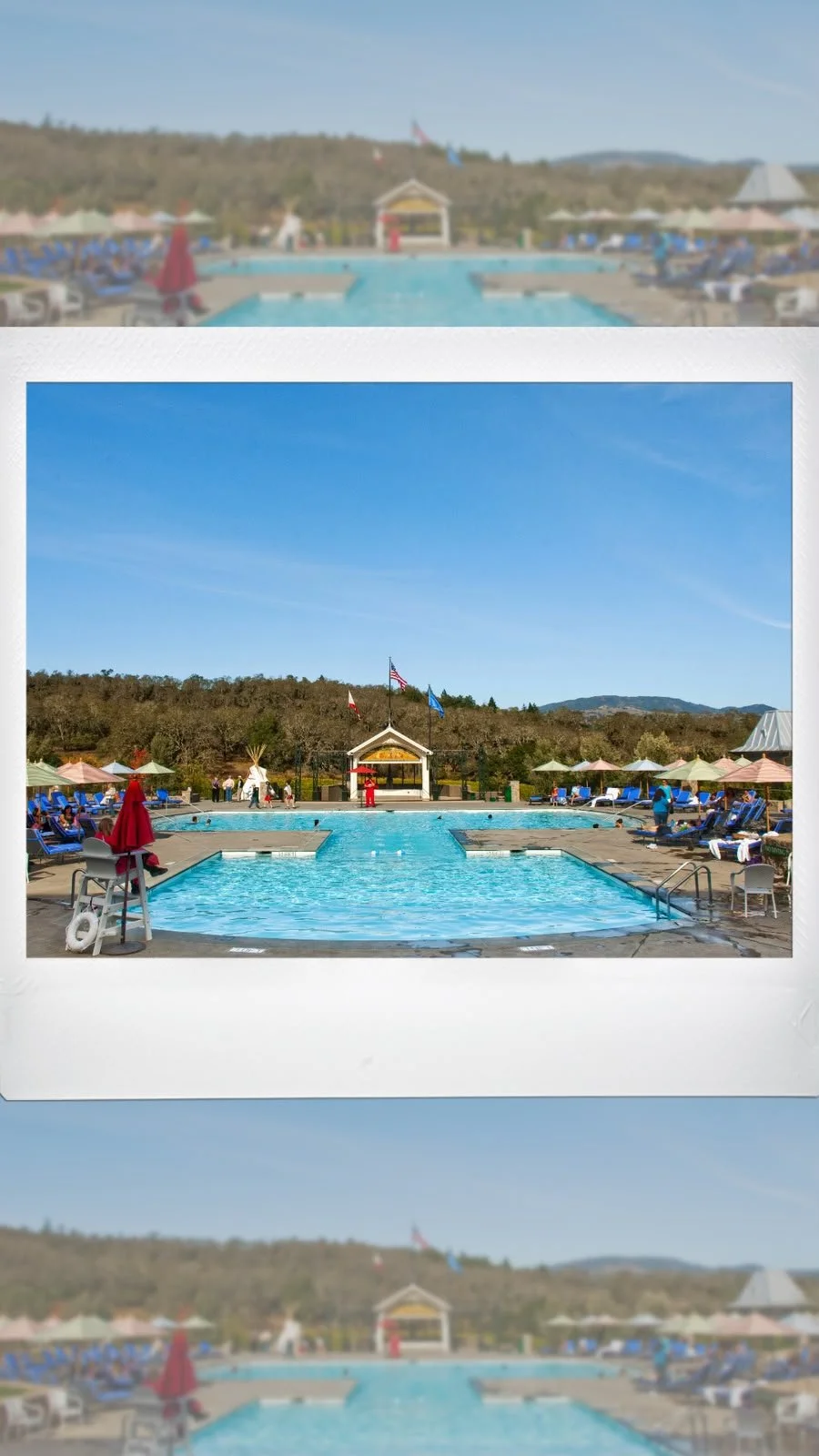
Every great estate contains one room that betrays its owner's true education, and at the Francis Ford Coppola Winery, the confession happens at the pool.

It is the cabins that do it. They line the water in painted rows, doors shut, order immaculate, and the effect is not Californian at all. It is Deauville. Anyone who has walked Les Planches, the boardwalk of that Norman resort, knows the ritual architecture by heart: the beach cabins of Deauville, each one bearing the name of a film star, a registry of cinema written on changing room doors, as if the movies, arriving every September for the festival, had been given lockers by the sea. France invented the idea that leisure deserves formality, that even swimming should have an antechamber, a threshold, a small room of one's own between the street clothes of life and the element itself.

Coppola, the most European of American directors, simply imported the grammar. A cabin is a fascinating unit of civilization when you think about it sociologically: minimum privacy, maximum ritual. Nothing happens inside a pool cabin except transformation. You enter dressed as your obligations and exit dressed as your afternoon. The stripe of paint, the numbered door, the bench: it is stage design for the daily theater of the resort, and a man who has spent his life building dressing rooms for other people's transformations would of course build them for his guests too, and line them up like a chorus.

And here is where the photographs from today turn quietly philosophical on me. These three days at the estate have been an education in how a filmmaker files his memories. The gate remembered the fairy tale. The roses remembered the discipline of beauty standing guard. The library and the teepee remembered the boy. The cabins remember the man at his most Francophile and precise: the director as a young cinephile in love with French cinema, who grew up to plant a Norman beach club, without a beach, in the middle of Alexander Valley, and dared the California sun to object. It did not object. It collaborated, the way light always collaborates with Coppola.

A pool is just water with architecture. A pool with cabins is water with a past, and a guest list written on the doors of small painted rooms, waiting for summer to call their names.

Yi Zhou

The Architecture of Fantasy: Inside the Francis Ford Coppola Winery

📷 photos courtesy of Francis Ford Coppola Winery and Yi Zhou Studio

Once upon a time is not a metaphor at the entrance to the Francis Ford Coppola Winery. It is an architectural decision.

The gate announces it before anything else can: two towers of warm stone, lanterns on top like a pair of patient guards, and between them an arch carrying the name COPPOLA in gold, set into a band of harlequin diamonds, green and black and white. The harlequin is the tell. Before the visitor has seen a single vine, the estate has confessed its ancestry: the Commedia dell'arte, the Italian theater of masks, the jester's pattern stretched across a king's entrance. Only a filmmaker would understand that combination instinctively. Majesty, but make it theater.

And then the eye travels down the drive, past the trees standing in their green formation, and finds the pyramid. A pyramid, in Alexander Valley, rising behind the road like a set piece that escaped from a dream sequence. It makes no agricultural sense and complete Coppola sense. This is the man who built a war in the Philippines because the script required a war, who has spent a lifetime refusing to let budgets edit his imagination. A winery, for him, was never going to be a business with vines attached. It was going to be another production, the longest running one of his life, with the landscape as cast and the seasons as schedule.

That is the fairy tale logic of the place, and it is more serious than it first appears. A gate in a fairy tale is never decoration. It is a contract: leave the ordinary rules on the highway, they say, and inside, other laws apply. Inside this one, a director's whole mythology is kept in working order, cinema remembered among the vineyards, objects from the films preserved like relics in a chapel of one's own making. Most men, at the summit of a career, build monuments to be looked at. Coppola built a world to be entered.

Every kingdom in the old stories is also a self portrait, and this one portrays a particular idea of the artist: not the tortured tenant of a garret, but a sovereign of abundance, for whom wine, food, film, and family are one continuous feast of making things. You can disagree with the philosophy, but standing at that gate, in that light, you cannot call it anything less than fully believed.

More from inside the gate, in the next few days.

Yi Zhou